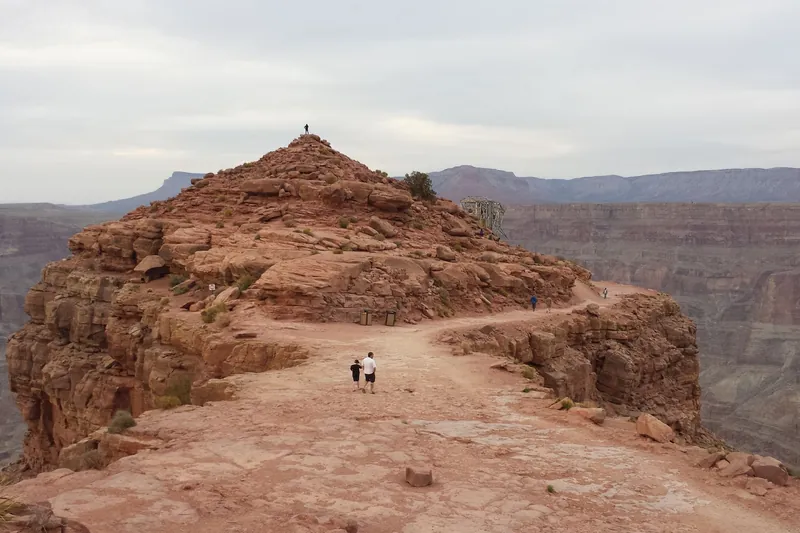
Hualapai history and culture
Grand Canyon West lies on the reservation of the Hualapai Tribe, and the tribe’s own company runs it. This page covers who the Hualapai are, what happened to them in the 19th century, and what that means for a visit today.
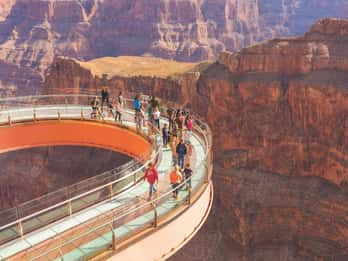
West Rim and Hoover Dam with breakfast and BBQ lunch
Coach with guide and driver, Skywalk optional · 10 hours
✓ Free cancellation
from $99
Book on GetYourGuide
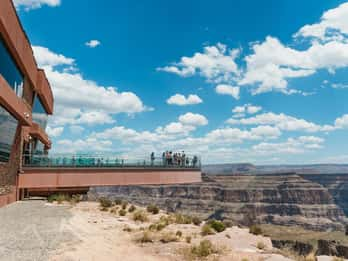
Small-group West Rim with Skywalk, breakfast and lunch
Small group, Skywalk included · 12 hours
✓ Free cancellation
from $220
Book on GetYourGuide
Grand Canyon West lies on the Hualapai Reservation in northwestern Arizona. The site is run by Grand Canyon Resort Corporation, founded in 1988 and wholly owned by the Hualapai Tribe. It is not part of Grand Canyon National Park, and the tribe collects its own fees to enter any part of the reservation.
The tribe gives the pronunciation of its name as Wal-lah-pie and the meaning as “People of the Tall Pines”. In the tribe’s language the name is Hwal’bay, the form the National Park Service also uses in its list of tribes associated with the Grand Canyon. Older documents spell it Walapai. According to the tribe, membership is about 2,300, including members who live off the reservation; the operator of Grand Canyon West gives a slightly higher figure.
The homeland before the reservation
According to Grand Canyon West, the ancestral lands of the Hualapai covered more than 7 million acres, beginning at the Little Colorado River and running downstream through the entire Grand Canyon. An encyclopedia entry by the anthropologist Thomas R. McGuire describes an economy based mainly on hunting and on gathering wild foods by season. Agave was collected in the canyons and foothills in spring, and diversion dams watered gardens of squash, maize, beans, watermelons and wheat.
The people lived in bands, and the sources count them differently: the Cline Library at Northern Arizona University and the operator speak of 14, while McGuire describes three named subtribes made up of several bands each. The Hualapai are culturally related to the Havasupai, whose language is close to their own. For the Hualapai, as for the Hopi and Zuni, the Grand Canyon is the place of their origin stories, the National Park Service writes.
War and the Long Walk to La Paz
Anglo-American exploration of the region, McGuire writes, began two decades of conflict with the Hualapai. The Hualapai War was fought in the late 1860s along the toll road between Fort Mohave and Fort Whipple; the NAU Cline Library dates it to 1865–1869 and records the surrender in 1869.
In April 1874 the US military forcibly moved hundreds of Hualapai to the Colorado River Indian Reservation near Parker, a place the tribe calls La Paz. Children, old people and the sick died on the two-week march, according to a report in the Parker Pioneer, and NAU records that many died of disease and hunger in the camp. The sources give no reliable total for the dead. In 1875 the survivors escaped and returned to northwestern Arizona. Grand Canyon West calls the deportation the Long Walk to La Paz.
The tribe remembers it in two ways that visitors can find. Each year the La Paz Run covers almost 200 miles from Ehrenberg, near the old camp, to Peach Springs. And at Ehrenberg the tribe has put up a memorial stone honouring the ancestors who died in captivity.
The reservation of 1883
An executive order of 4 January 1883 created the reservation on a small part of the old homeland. Today it covers about 992,462 acres of tribal trust land, and its northern boundary follows the Colorado River through the Grand Canyon for 108 miles, according to the US Department of the Interior. Living conditions did not improve much with it, McGuire notes.

The land question reached the Supreme Court in 1941. In United States v. Santa Fe Pacific Railroad Co., the court held that the Walapai right of occupancy to the lands in question had not been extinguished, but it also treated the tribe’s acceptance of the reservation as giving up claims to land outside it.
Tribal government and Peach Springs
The Hualapai Tribe is a sovereign nation with an executive and a judicial branch. Its constitution, adopted under the Indian Reorganization Act, was approved on 17 December 1938 and set up a Tribal Council of nine members: today a chairman, a vice-chairman and seven council members. The tribal capital is Peach Springs on Route 66, where most residents of the reservation live, and the tribe’s own radio station, KWLP 100.9 FM “The Peach”, broadcasts from there.
The tribe names tourism, cattle ranching and arts and crafts as its main economic activities. Besides Grand Canyon West it runs Hualapai River Runners, which it describes as the only Indian-owned and operated rafting company on the Colorado River; the trips start from Peach Springs and are covered on our Colorado River page.
The Hualapai language
Hualapai belongs to the Yuman language family and forms the Upland Pai group together with Havasupai and Yavapai. In 1975 the school in Peach Springs started a bilingual programme, built on a curriculum developed by the teacher Lucille Watahomigie, who later directed what a 1997 paper calls the nationally recognised Hualapai Bilingual/Bicultural Program.
The work continues through the tribe’s Department of Cultural Resources. Children in Head Start are taught through immersion for four hours a day, and the department runs a yearly PAI Language Immersion Camp and classes in pottery and cradleboard making. The department also writes that it still struggles to produce new fluent speakers. In 2022, 34 community speakers took part in a language project on KWLP.
Water on a dry rim
Water is one of the reservation’s hardest problems, and it affects Grand Canyon West directly. For more than ten years the site drew groundwater through a pipeline about 35 miles long. In 2019 the well supplying it went dry. Since then, the Department of the Interior reported in 2022, the tribe has hauled water about 30 miles from a well near Peach Springs to the old well site and piped it on from there. The operator’s own history page gives a much longer distance; the figure here is the government’s.
The Hualapai Tribe Water Rights Settlement Act of 2022, signed into law on 5 January 2023, provides for a Hualapai Water Project to deliver up to 3,414 acre-feet of Colorado River water a year, and sets up a trust fund of 312 million dollars. The sources used for this page do not say how far construction has progressed.
The Skywalk as the tribe’s decision
Grand Canyon Resort Corporation dates from 1988; the Skywalk opened on 28 March 2007. In the words of the National Park Service, the tribe chose a site at the far western end of the Grand Canyon. Before the pandemic, the Department of the Interior reported, more than a million people a year came to Grand Canyon West, making it the primary economic driver on the reservation.
The project divided opinion. At the opening, NPR spoke to the tribal member Sylvia Querta, who saw the Skywalk as economic progress and a source of jobs, and to Consuela Bravo, who had first thought it a bad idea because it disturbed the land. The elder Emmit Bender blessed the project with a song. From outside the reservation came criticism: Rob Arnberger, a former superintendent of the national park, told NPR the structure was not consistent with what the canyon represents to the world. The operator says the horseshoe shape of the bridge reflects the tribe’s traditional architecture. Our Skywalk page covers the visit itself.
Eagle Point, the village and the Bird Singers
The Hualapai name for Eagle Point is Sa’ Nyu Wa, after a rock formation shaped like an eagle. The operator tells the story behind it: an eagle saved the tribe’s ancestors from a flood in the Grand Canyon by flying them to the west rim, and then turned to stone. It describes the eagle as carrying the spirits of the dead as well.
Next to the viewpoint, the Native American Village is a self-guided path past traditionally built houses, ovens and sweat lodges of the Hualapai, Navajo, Hopi, Havasupai, Plains and other peoples. In the outdoor theatre the Hualapai Bird Singers perform: the men sing in Hualapai to drums and rattles, the women dance, and the songs tell of the flood and the eagle. In the operator’s description, the beadwork of the dancers’ dress stands for the breast of the eagle and the shawls for its wings. The operator’s pages give different days and times for the performances, so ask at the terminal on the day. The free shuttle continues to Guano Point and to Hualapai Point, where the Hwal’bay Gallery (pronounced wall-by) shows Hualapai stories collected by the Department of Cultural Resources.
Visiting with respect
The tribe publishes its own rules for visitors, and most of them follow from the fact that this is lived-in land. Treat the Hualapai staff with respect and do not touch their hair or clothing; the tribe encourages questions about its culture and traditions. Taking animals, plants, rocks or artefacts is prohibited, as is damaging rock formations. Scattering human ashes is not allowed, with no exceptions. If you drive through Peach Springs, stay off residential land and do not enter a home uninvited. Campfires and grills are banned because of the wildfire risk, and drones, firearms and alcohol you bring yourself are not permitted. The operator also asks visitors to recognise the site as sacred to the Hualapai.
The tribe’s published rules do not mention photographing people. Our own suggestion is to ask before you photograph staff or performers up close.
All tours side by side
Passes and day trips that include time at Eagle Point, where the Native American Village and the outdoor theatre are.
| Tour | Format | Duration | Age | Rating | From |
|---|---|---|---|---|---|
| West Rim and Hoover Dam with breakfast and BBQ lunchComedy on Deck ToursA coach with an on-board toilet stops for a sit-down breakfast and Hoover Dam photos, and at the West Rim a BBQ lunch is served at Guano Point. | Coach with guide and driver, Skywalk optionalHotel pickup, Grand Canyon West entry, breakfast, BBQ lunch, water | 10 hoursPickup at selected Strip and Downtown hotels | – | 4.8 (4,258 reviews) | From $99Free cancellationBook on GetYourGuide |
| Coach tour with West Rim entry and add-on optionsJupiter Legend CorporationA coach with Wi-Fi stops at the Memorial Bridge above Hoover Dam and gives you more than three hours at Eagle Point and Guano Point, with Skywalk, lunch, flights and a pontoon cruise as options. | Coach, Skywalk and flights optionalHotel pickup (selected hotels), West Rim entry, water, snacks, Wi-Fi | 10.5 hoursPickup at selected Las Vegas hotels | Children aged 2 and over need a car seat or booster | 4.8 (1,013 reviews) | From $99Free cancellationBook on GetYourGuide |
| Small-group West Rim with Skywalk, breakfast and lunchGrand Adventures ToursGroups of eleven or fewer get a guided walk over Hoover Dam, a stop in a Joshua tree forest and guided walks at Eagle Point and Guano Point, with breakfast and a picnic lunch. | Small group, Skywalk includedHotel pickup, Skywalk pass, breakfast, picnic lunch, water, Hoover Dam walk | 12 hoursPickup at Las Vegas hotels | Children under 7 need the operator’s permission | 4.9 (522 reviews) | From $220Free cancellationBook on GetYourGuide |
| All Access Pass with SkywalkGrand Canyon Resort CorporationThe All Access Pass combines Skywalk entry at Eagle Point with the shuttle to the three viewpoints, one zip line ride when available, arcade play and food and retail vouchers. | Ticket, All Access PassSkywalk entry, locker, arcade play, food and retail vouchers | Grand Canyon West (no transport) | – | 4.3 (320 reviews) | From $114Free cancellationBook on GetYourGuide |
Prices and ratings come from the booking platform and are shown in US dollars per person. If you book through these links we earn a commission. Your price stays the same. Sorted by number of reviews.
Questions travellers ask
How do you pronounce Hualapai?
The tribe gives the pronunciation as Wal-lah-pie and the meaning as “People of the Tall Pines”. Older documents, among them the 1938 constitution, also use the spelling Walapai.
Is Grand Canyon West part of Grand Canyon National Park?
No. It is on the Hualapai Reservation and run by a company owned by the tribe. The National Park Service notes that the tribe collects its own fees, and the operator says national park passes are not accepted.
What was the Long Walk to La Paz?
In 1874 the US military forcibly moved hundreds of Hualapai to the Colorado River Indian Reservation near Parker, a place the tribe calls La Paz. Many died on the march and in the camp. Survivors escaped in 1875 and returned home; the annual La Paz Run remembers them.
Can I see Hualapai song and dance at Grand Canyon West?
Yes. The Hualapai Bird Singers perform in the outdoor theatre at Eagle Point, and the operator’s ticket page lists the performances in both the All-Access Pass and General Admission. The operator’s pages give different days and times, so ask at the terminal.
Does the money from Grand Canyon West go to the tribe?
Grand Canyon Resort Corporation, which runs Grand Canyon West, is a wholly owned enterprise of the tribe. In 2022 the US Department of the Interior described Grand Canyon West as the primary economic driver on the reservation.
What should visitors avoid?
The tribe asks visitors not to touch the hair or clothing of Hualapai staff, not to take rocks, plants, animals or artefacts, not to scatter ashes, and not to enter homes or residential land. Drones, firearms and your own alcohol are not allowed.
Where these facts come from
Dates, opening hours and rules change. We checked these pages in November 2026; the official source has the final word.
- Hualapai Tribe: About the Hualapai Tribe
- Hualapai Tribe: Department of Cultural Resources
- NAU Cline Library, Indigenous Voices of the Colorado Plateau: Hualapai overview
- NAU Cline Library, Indigenous Voices of the Colorado Plateau: Hualapai events
- University of Arizona, NAAIR: Hualapai Tribe
- Thomas R. McGuire: Walapai, Encyclopedia of World Cultures
- Parker Pioneer: Hualapai tribe commemorates Trail of Tears (20 April 2016)
- Historical Marker Database: Hualapai marker near Ehrenberg
- US Department of the Interior: Statement on H.R. 7633 (12 May 2022)
- Public Law 117-349: Hualapai Tribe Water Rights Settlement Act of 2022
- Constitution and By-Laws of the Hualapai Tribe (1938), University of Oklahoma Law Library
- United States v. Santa Fe Pacific Railroad Co., 314 U.S. 339 (1941)
- Stabilizing Indigenous Languages: Schools, developmental session summary (NAU)
- AILDI: Hualapai Department of Cultural Resources
- Cultural Survival: Radio KWLP promotes Hualapai language and culture on air (25 January 2023)
- NPR: Skywalk opening, Morning Edition (2007)
- National Park Service: The Hualapai Tribe and Skywalk
- National Park Service: Associated tribes
- National Park Service: Sacred canyon
- Grand Canyon West: Meet the Hualapai Tribe, rules and customs
- Grand Canyon West: Hualapai Tribe history
- Grand Canyon West: The meaning behind the sacred places
- Grand Canyon West: Skywalk and the cultural significance of Sa’ Nyu Wa
- Grand Canyon West: Hualapai experiences
- Grand Canyon West: Landmarks and culture
- Grand Canyon West: Tickets and deals
- Grand Canyon West: FAQs
- AZ Big Media: Grand Canyon West celebrates 30th anniversary
- Tour pages on GetYourGuide and Viator, checked 11 November 2026